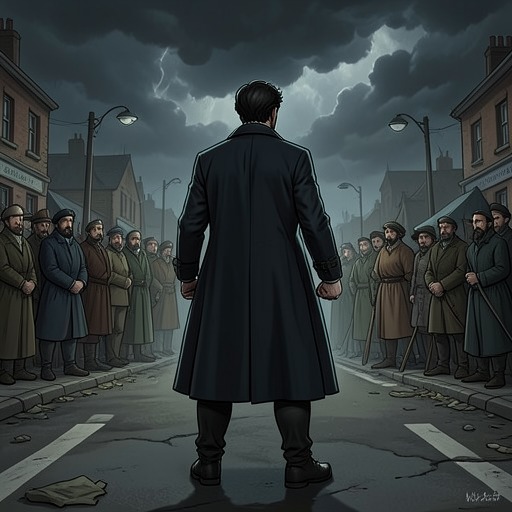
Dorian as the last surviving demigod
The Night CleanerDorian as the last surviving demigod is a condition forged by both mass slaughter and a narrowly successful escape: the gods’ children were left to die, and Dorian alone survived by drinking a tonic that made him appear dead. It marks the rupture between the healer he had been and the embittered survivor he became, while exposing the divine order that chose Draco to protect humanity after abandoning the demigods.
Identity and Background
Dorian was a demigod and the son of Apollo, whose domains included the sun, music, medicine, and prophecy. He had been a healer, and he used his abilities to help humanity. That service was also bound up with his desire for his father’s approval: he continued doing the work associated with Apollo even as the gods’ eventual decision revealed how little that service protected their children.
His account distinguishes demigods from people whose powers were bestowed by the gods. The latter were chosen and did not have divine blood in their veins; demigods, by contrast, were the gods’ own children. The difference matters to Dorian because the gods’ concern for humanity did not extend to preserving their demigod offspring. In his understanding, the gods ensured that humanity could be protected after their own departure, yet treated even the good among their children as expendable.
The Slaughter and His Survival
Dorian’s memory of the catastrophe is populated by dead brothers and sisters. He checked them for signs of life, but found none; he understood that demigods had been killed by one another and by the beings who had given them life. The loss was not simply the defeat of a group. It erased the family and community to which he belonged.
He had prepared a tonic in his garden that would make him and Jasmine appear dead, intending for them to escape the killings together. But Jasmine was lost amid the violence, and Dorian was cornered in a temple. He drank alone. When he awoke days later, every other demigod had been slain. His survival therefore came at the cost of the shared escape he had planned: the means that concealed him from his killers could not save Jasmine or restore the rest of his family.
Years later, when Esme asked how he had survived, Dorian explained that the tonic had made him seem dead and that he had awakened after everyone else was gone. He also told her that he had served in battle as a healer and witnessed the gods’ ending with her brother. The retelling makes his singular survival more than an isolated piece of background: it is the account through which Esme learns both of his place in the slaughter and of the concealed family connection between them.
The Gods’ Choice of Draco
Dorian witnessed the gods choose Draco as their leader of heroes. They gave Draco their power and marked him with symbols of their divine blood; after the last god had done so, the gods disappeared. Dorian’s recollection sets that empowerment beside the deaths of the demigods, making the transfer of divine favor an immediate contrast: a new protector was appointed for mankind while the gods’ own children had been destroyed.
The result was not only Draco’s leadership. The gods made him immortal and charged him with protecting humanity after the extermination of the demigods. Dorian was excluded from that new arrangement. He remained alive, but the gods’ decision offered him neither the recognition nor the role they granted Draco. The contrast between the chosen hero and the surviving demigod defines the injustice at the center of Dorian’s remembered past.
Loss, Anger, and Consequences
Dorian’s response to survival is shaped by grief for his family, anger at the gods, and bitterness at the fate assigned to him. The memory returns in a nightmare that he recognizes as his worst one, and its recurrence keeps the slaughter present rather than safely distant. Even as he lies beside Esme, the memory begins again; he knows he can only watch it unfold. The remembered dead, including Jasmine, make his past a continuing emotional burden rather than a concluded history.
Jasmine had shared Dorian’s commitment to helping humanity. They had been together briefly, loved one another, and imagined working in temples of healing. Dorian had also foreseen a future in which they married, had children, and died together. The massacre broke not only that imagined life but their intended escape: he could not find her in time to drink the tonic with her, and his survival left him without the future he had seen.
The account also explains why Dorian’s later sense of exclusion carries such force. He remembers that he had once been good and had served humanity as a healer, yet the gods deemed demigods expendable regardless of their conduct. His survival preserved a witness to that contradiction: the person who lived was not the one the gods selected to lead their heroes, but the one who woke to discover that his people were gone.
Narrative Significance
Dorian’s status as the last surviving demigod is both a literal consequence of the massacre and the defining context for his grievance. The account links his former service, his father’s approval, and the destruction of his family to a divine choice that elevated Draco and left Dorian behind. His survival is therefore a second, harsher distinction: he is the exception among the dead, but not the beneficiary of the gods’ favor.
The story returns to this history through Dorian’s nightmare and later through his explanation to Esme. Those tellings connect the private experience of loss to the larger history of the gods’ actions, while revealing that the catastrophe shaped his identity long after it ended. He survives the slaughter, but survival does not restore his family, Jasmine, his envisioned future, or his former faith in the order he once served.